Free Keyboard lessons for beginners – part 9.
Welcome to part nine of our beginner lessons. On this page we shall take a look at the following:
- Triads
- Relative minor
- The Key of A minor
- The three kinds of minor scales (natural, harmonic and melodic)
- The A Harmonic Minor Scale
Recommended: Click here for the BEST piano/keyboard course I’ve come across online.
- Accidentals
- Primary chords in A minor
- The key of D Minor
- The D Harmonic Scale
- Primary chords in D minor
Triads
A triad is a three-note chord consisting of a “root” note together with the third and fifth above it. So in the case of a C chord, the root is C, the third is E and the fifth is G.
Watch this lesson:
Primary triads in the key of C: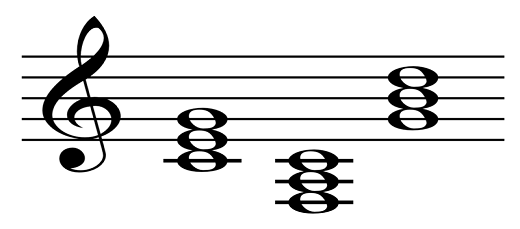
Triads may be built on any note of the scale. Example, C-E-G, D-F-A, E-G-B, F-A-C, G-B-D, A-C-E, and B-D-F. As can be seen, one letter of the alphabet has been skipped between each note. Try out these different root positions and listen carefully to their sound.
In this free keyboard lesson we shall take a look at two different kinds of triad. They are the major triad and minor triad.
A major triad consists of a major 3rd. There are 4 half steps from the root to the 3rd. It consists of a perfect fifth (7 half steps between the root and the fifth). Major triad = root, major 3rd and perfect 5th.
A minor triad consists of a minor 3rd. There are 3 half steps from the root to the 3rd. It also consists of a perfect fifth. Minor triad = root, minor 3rd and perfect 5th. To change from a major triad to a minor triad simply lower the 3rd one half step.
For instance, a C chord is a major triad and consists of the notes C, E and G. A Cm (C minor) chord is a minor triad and consists of the notes C, E♭ and G.
Types of triads: (For now, check out the first two triads in particular.)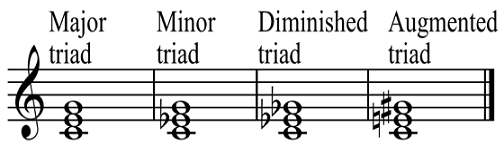
Rocket Piano is one of the best courses I’ve come across on learning to play keyboard and piano. Learn to play the keyboard properly. Click here for keyboard lessons with Rocket Piano.
The Key of A Minor (Relative of C major) – (Free Beginner Keyboard Lessons)
The relative minor starts three semitones below its relative major, or the 6th tone; for example, A minor is three semitones below its relative, C Major or on the 6th tone of the scale. The relative minor of a particular major key has the same key signature (no sharps, no flats) but a different root. The relative minor of C is A minor. In the same way, F and D minor are relatives. G and E minor are relatives.
Minor scales
There are three types of minor scales. They are the
- natural minor scale
- harmonic minor scale
- melodic minor scale
The natural minor scale uses only the tones of the relative major scale. Therefore, the A natural minor scale is A B C D E F G. You simply play all the white notes from the sixth of the C major scale.
The harmonic minor scale uses the tones of the major scale except for the 7th tone, G. The 7th tone is raised half a step, ascending and descending. The A harmonic minor scale is A B C D E F G♯.
Accidentals
Since G♯ is not contained in the key signature, it is called an accidental. An accidental is a note whose pitch is not a member of a scale indicated by the most recently applied key signature.
Accidentals – sharp, flat, natural:
The melodic minor scale is separated into two scales, the ascending melodic minor scale and the descending melodic minor scale. In the ascending scale the 6th (F) and 7th (G) are raised a haf step. The A ascending minor scale is A B C D E F♯ G♯. The descending melodic minor scale is the same as the natural minor scale.
As part of these free keyboard lesssons, practice the three minor scales above until you have learned them well.
The primary chords in A minor are A minor (Am), D minor (Dm) and E major (or E7).
As we said earlier, D minor is the relative of F major. Both keys have the same key signature with one flat, B♭ We’ve already seen that the relative minor begins on the 6th tone of the major scale.
The D natural minor scale is D E F G A B♭ C
The D harmonic minor scale is D E F G A B♭ C♯
The ascending D melodic minor scale is D E F G A B C♯ and descending, it’s the same as the natural minor scale.
The primary chords in D minor are D minor (Dm), G minor (Gm) and A major or (A7). Practice these chords as part of our beginner keyboard lessons.
To speed up the piano/keyboard learning process I strongly suggest that you check out Rocket Piano Lessons.
Keyboard Lessons:
- Lesson One
- Lesson Two
- Lesson Three
- Lesson Four
- Lesson Five
- Lesson Six
- Lesson Seven
- Lesson Eight
- Lesson Nine
- Lesson Ten
- Lesson Eleven
- Lesson Twelve