Music key signatures are sharps and flats immediately following the clef sign. These sharps and flats (accidentals) affect every note on the line or space they represent throughout the entire composition. The only times they don’t affect a note are when there’s a natural sign on that note or when there’s a key change.
My #1 Recommendation: Go here to learn about the BEST piano/keyboard course I’ve seen online.
For instance, let’s take a look at the signature for the key of G or E minor. Notice that the sharp sign is over the F line in the treble clef as well as the bass clef.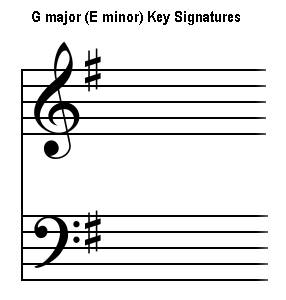
This means that every time the note F appears, it will be raised by a semitone to F sharp.
Another example is the key of F Major or D minor. Notice theflat sign over the B line in both the treble and bass clef?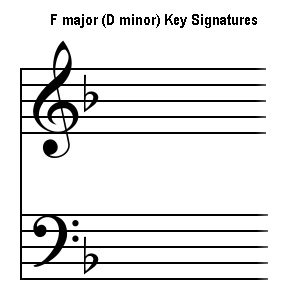
It flattens the note B by a semitone. So every time the note B appears, the note B flat is played instead.
Key signatures help to reduce on the number of accidentals that would be in a piece of music if they were not present. They make it so much easier to read music.
Major keys all have a relative minor key. For instance, the relative minor key for C major is A minor. The relative minor for F major is D minor. A major key and its relative minor key make use of the same scale. They have the same signatures. Music written in minor keys often sound sad while those in major keys sound happier.
Here’s a diagram showing the different key signatures, major and minor on the bass and treble clef.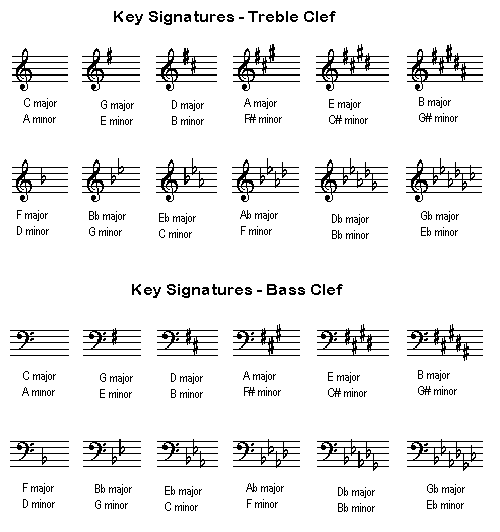
Learn about key signatures (and how to play piano) with Rocket Piano lessons.
Each music key signature comes with a particular number of sharps and flats. These sharps and flats have a particular order as you will notice below.
Sharp keys, the number and order of sharps
Let’s take a look at sharp keys and the number of sharps they come with, as well as the order of sharps.
C major has no sharps or flats.
G major has one sharp, F#
D major has two sharps, F# C#
A major has three sharps, F# C# G#
E major has four sharps, F# C# G# D#
B major has five sharps, F# C# G# D# A#
F# major has six sharps, F# C# G# D# A# E#
C# major has seven sharps, F# C# G# D# A# E# B#
Flat keys, the number and order of flats
Let’s take a look at flat keys and the number of flats they have.
F major has one flat, Bb
Bb major has two flats, Bb Eb
Eb major has three flats, Bb Eb Ab
Ab major has four flats, Bb Eb Ab Db
Db major has five flats, Bb Eb Ab Db Gb
Gb major has six flats, Bb Eb Ab Db Gb Cb
Cb major has seven flats, Bb Eb Ab Db Gb Cb Fb
As seen above the order of sharps are F# C# G# D# A# E# B#.
The order of flats are Bb Eb Ab Db Gb Cb Fb.
The order of flats are opposite to the order of sharps. You will notice that the first four letters in the order of flats spell the word BEAD. Here’s a trick to remember the order of sharps. Learn this line: Fat Cats Go Down Alleys Eating Birds. Memorize this pattern of letters forwards and backwards to remember the order of sharps and flats.
The following diagram shows the cycle of keys or circle of fifths (circle of fourths). You will also see the relative minors.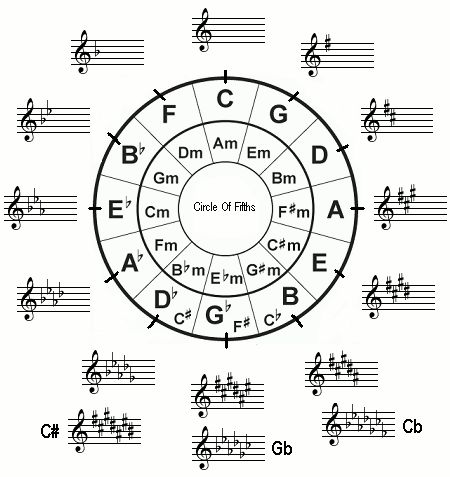
Here’s another chart showing major keys and their relative minors.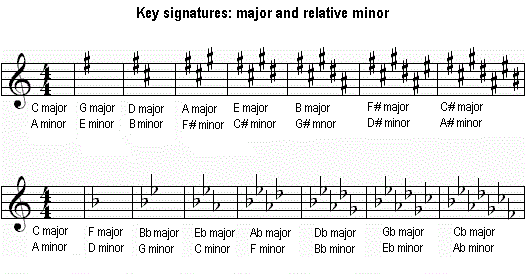
Understanding music key signatures
Here’s one way you can look at major music key signatures and know what keys they represent. If the signature has sharps, identify the last sharp and raise it by a semitone (half step). For instance if the last sharp is F#, raise that note by half a step. This takes us to G. The key is G. If the last note in the signature is C sharp, raise it by a half step to D. In this case, the key is D.
How about flat keys? If the signature has flats, simply look at the note before the last. That note tells you the key. For instance, E flat major has three flats. The note before the last is E flat. The key is E flat.
The only exceptions to this rule are C since it has no sharps and flats, and F, since it has one flat.
How do you find the relative minor key? Simply find the name of the major key and lower it by three half step. For instance if the key is C major, lower C by three half steps. This takes us to A minor. If the key is D major, three half steps lower takes us to the relative minor key, B minor.
My best recommendation on this site for piano lessons is Piano For All. Check it out. Click here to learn all about Piano For All.
Music Theory Lesson – Major Keys, Key Signatures & Scales in Circle of Fifths Order
Return to Piano Keyboard, Piano Lessons home page.