In search of free piano lessons for beginners? This site contains a number of them. In this twelfth online piano lesson we take things to another level. We shall take a look at the following:
Inversion of triads: Triads in all positions
- Root position
- 1st inversion
- 2nd inversion
Highly Recommended: Click here for the BEST piano/keyboard course I’ve come across online.
Have you checked out our previous free piano lessons? When you have mastered them, you will be ready to proceed to this current one.
We’ve already looked at triads and how they are formed. A triad is a three-note chord that can be stacked in thirds. A triad consists of the root note, the third and the fifth. There are major and minor triads. For instance, the chord C major is a major triad and is formed with the notes C E G. The chord Am (A minor) is a minor triad and is formed with the notes A C E. In the case of a minor triad, the minor third (in the above example, C) is 3 half steps above the root.
Until now we have only looked at triads in root position. As part of our free piano lessons for beginners let us now look at inversions. We’ll start with 1st inversions.
Any root position triad may be inverted by moving the root to the top. So in the case of the chord C, instead of playing C E G, you play the first inversion E G C. All letter names remain the same, but the root is at the top. To play the C chord in root position, you use the fingers 1 3 5. To play it in the first inversion use 1 2 5.
Learn how to play piano chords with the Piano For All piano course.
How about the chord, F? In root position you would play F A C. In the 1st inversion, you move the root note, F to the top and play A C F. Between the notes A and C, the interval is a 3rd. Between the notes C and F, the interval is a fourth. Try it now on your piano or keyboard.
What are the notes for the chord Dm (D minor)? The notes are D F A. This is in the root position. To play the 1st inversion of D minor, you play F, A and D. Again, all we’ve done is simply move the root to the top. The root note is now one octave higher.
How about the minor triad A minor? In the first inversion the notes would be C E A.
As part of your free piano lessons for beginners, practice inverting triads on your piano. Triad inversions are quite interesting!
Here are piano pictures of a C major triad in root position, 1st inversion and 2nd inversion. (I will go through second inversions next.) You can choose different chords and form your own.
C Major Triad
Root Position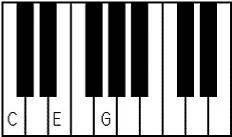
1st Inversion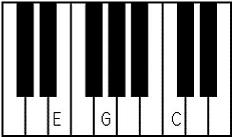
2nd Inversion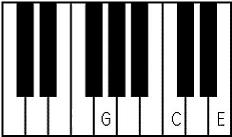
As we continue our free piano lessons for beginners, we move to 2nd inversion triads. You can invert the 1st inversion again by moving the lowest note to the top. All letter names remain the same but the root is in the middle. In the second inversion the root is always the top note of the Interval of a fourth.
Here’s an example of the 2nd inversion of a chord on piano. Let’s say we have a G chord. In the root position the notes are G B D. In the first inversion the notes would be B D G. In the 2nd inversion the root note, G comes in the middle so the notes are D G B.
Here are piano pictures of an A minor triad in root position, 1st inversion and 2nd inversion.
A Minor Triad
Root Position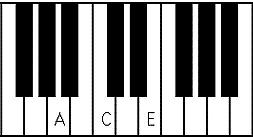
1st Inversion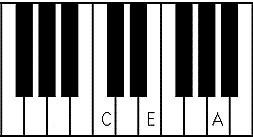
2nd Inversion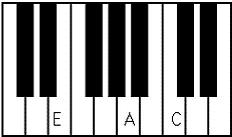
Recap
If the root is at the bottom, the triad is in the root position. If the root is at the top the triad is in the 1st inversion. If the root is in the middle, the triad is in the 2nd inversion.
When triads are inverted, major triads remain major; likewise, minor triads remain minor. Practice playing and writing major and minor triads in root position, 1st inversion and 2nd inversion.
Image of C triad in root position, 1st inversion and 2nd inversion
Piano Chords
Piano Chords – learn how to build chords on piano.
Click here to learn about my top recommendation for learning to play piano.
LESSONS:
- Free Piano Lessons – Page One
- Online Piano Lessons – Page Two
- Free Online Lessons (Piano) – Page Three
- Beginner Piano Lessons – Page Four
- Easy Piano Lessons – Page Five
- Learn Piano Online – Page Six
- Learn to Play the Piano – Page Seven
- Learn to Play Piano – Page Eight
- Keyboard Lessons – Page Nine
- Beginner Keyboard Lessons – Page Ten
- Learn Piano Online – Page Eleven
- Free Piano Lessons For Beginners – Page Twelve
Return from Free Beginner Piano Lessons Online to home page.